|
Central Limit Theorem Applet
The attached
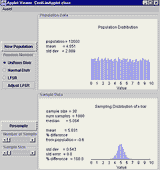
applet simulates a population by
generating 10,000 floating point random numbers between 0 and 10. Each
time the "New Population" button is pressed it generates a new set
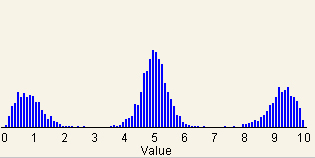
of random numbers. The plot labeled Population Distribution shows
a histogram of the 10,000 data points.
The applet provides three different random
number generators with, at least, slightly different
characteristics. The "Uniform Distr" option uses a standard pseudo
random number generator from the Java language. The "Normal Distr"
option is also from Java but generates pseudo random numbers with
a Normal Distribution. "LFSR" stands for linear feedback shift
register. It’s a pseudo random number generator which has been
used in cell phone communications.
All three systems are referred to as pseudo
random
number generators since they generate numbers from equations which
over a long period of time repeat. However, the numbers
they generate are very similar to ideal random numbers.
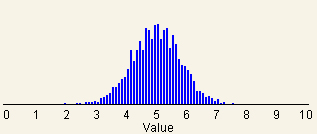
Below this plot is a sampling distribution of
x-bar. Each time the resample button is pressed a new set of
samples is obtained from the population and the sampling
distribution is re-plotted.
The slider called "Sample Size" helps illustrate
the central limit theorem. When the sample size is increased, the
sampling distribution becomes narrower as predicted by equation
(1). Note that the sampling distribution starts to look like a
normal distribution even with a sample size = 2.
As mentioned earlier, the central limit theorem
is arguably only the second most important principle in
statistics. The law of large numbers is even more basic than the
central limit theorem and so can be considered more important. It
says essentially that probability and statistics can only predict
overall results for a large
number of data points or trials. For example, toss a coin
thousands of times and it will come up heads in almost exactly 50%
of the tosses. Toss it three times and it can never come up heads
50% of the time.
Each sampling distribution data point is an
x-bar calculated from an individual sample. The law of large
numbers indicates that it will take a lot of these x-bars to make
the sampling distribution look like it’s normally distributed. The
"Number of Samples" slider can be used to illustrate this point.
Reduce the number of samples to the minimum and the sampling
distribution starts to look like a sprinkling of random points
even when the sample size is large. Increase it to the maximum and
the normal distribution shape appears.
When playing with the applet remember to think
"central limit theorem" when changing the sample size and
to think "law of large numbers" when changing the number of
samples.
|
|
People come in a variety of shapes and sizes. Get a few
million people together in one place, say in Rhode Island or South
Carolina, and it would be impossible to predict what a single person
selected from either state would be like. Try to compare all Rhode
Islanders to all South Carolinians and the task gets even more complex.
Obviously, something is needed to simplify the process, and that’s why we
have statistics.
The first step is to decide on a measurement, such as
weight. Yes, this ignores that Mary Jane in SC has freckles and John in RI
has a tattoo but we have to focus on something or we can’t make a
comparison. Unfortunately, even after focusing on a single measurement, we
still have two different populations of data points consisting of millions
of wildly different numbers. These populations include everything from two
pound preemies to 400+ pound bubbas.
Again, we must simplify and so we’ll focus on a
parameter that can characterize the weights of all individuals in a
population. A parameter is a number which summarizes a specific
characteristic generated from measurements of every member of a
population. Using a parameter it’s possible to represent a property of an
entire population with a single number instead of millions of individual
data points.
There are a number of possible parameters to choose from
such as the median, mode, or interquartile range. Each is calculated in a
different manner and illuminates the data from a different point of view.
We’ll use the mean, because it’s one of the most useful and widely used.
In spite of its harsh sounding name it has a very nice effect on helping
us understand populations.
The mean, or average, summarizes something called
central tendency. This is a fancy way of saying what’s typical, normal, or
expected in a population. If all the data points were plotted on a line
segment the most typical values would be found somewhere near the center
of the line segment, hence, the term central tendency.
Of course central tendency isn’t the only issue. There’s
also the issue of variability or spread. We like to call this wildness
although, admittedly, wildness is not a standard term. However,
wildness seems appropriate, since, individuals drawn from populations
with lots of variability or spread tend to be wildly unpredictable.
While the mean gives us a single number to describe a
complex population, it’s, unfortunately, a parameter. We have to use every
single data point in a population to calculate a parameter. With millions
of data points to collect, this could be a real problem. By the time we
got all the measurements, the two pound preemies might have turned into
400+ pound adults.
The solution is to use a randomly chosen sample of the
population and calculate a statistic. Statistics are always based on
samples. We would carefully collect a few data points chosen at random and
calculate a sample mean. We’ll call this statistic x-bar. Clearly, x-bar
is not a parameter since it’s not calculated from the entire population.
It’s only an estimate of the parameter.
 |
|
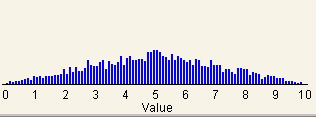
Fig. 1) Histogram of Population
- Uniform Distribution:
population = 10,000; mean = 5.013; std dev 2.897 |
| |
 |
|
Fig. 2) Sampling Distribution n
= 2: number of samples = 2010; mean = 4.995; std dev 2.011;
std error = 2.048 |
| |
 |
|
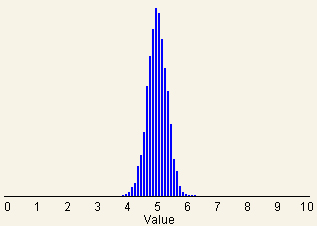
Fig. 3) Sampling Distribution n
= 10: number of samples = 2010; mean = 5.018; std dev 0.906;
std error = 0.917 |
| |
 |
|
Fig. 4) Sampling Distribution n
= 50: number of samples = 2010; mean = 4.999; std dev 0.411;
std error = 0.410 |
|
If we selected another sample and calculated a second
x-bar we might find that it differs considerably from the first. By their
nature, random samples can sometimes give unexpected results even when
flawlessly collected. For example, the first could be made up mostly of
preemies while the second could be made up of sumo wrestlers. While such
extremes are unlikely, selecting large sized samples would prevent them.
After all, there are just so many preemies and sumo wrestlers available. A
large sized sample could never be made up entirely of either preemies or
sumo wrestlers.
Ultimately, if one sample mean or x-bar is wildly
different from another we would not be any better off than trying to look
at the entire population. Obviously, we need to understand just how wild
or variable sample means or x-bars are likely to be.
To understand the wildness of samples, we would choose
thousands of samples, calculate an x-bar for each, and display the x-bars
in a histogram. We call this histogram a sampling distribution and when we
look at it we see something which is truly amazing. Sampling distributions
tend to be far less variable or wild than the populations they are drawn
from (See Fig.s 1, 2, 3 and 4.) They also have essentially the same mean as
the population.
What’s more, sampling distributions drawn from a
uniformly distributed population start to look like
normal distributions even with a sample size as small as 2 (see Fig. 2). If the sample
size is large enough they form nearly perfect normal distributions. This
may not seem Earth shattering but it’s really quite profound. Anytime we
know data follows a normal distribution, we immediately have a lot more
confidence that we can predict how the data will behave.
The situation is similar to hiring Mary Jane, who has a
master’s degree in computer science versus Jim Bob who says he can
compute. Jim Bob may turn out to be better at creating software. However,
by knowing that Mary Jane has a master’s degree we feel a lot more
confident in our ability to predict her programming capability.
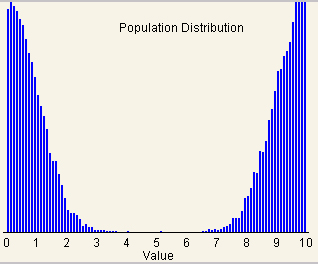
Although the figures at right are for a population with
a uniform distribution, the central limit theorem works well regardless of
the population's distribution. The applet illustrates this nicely. It
includes a highly skewed as well as a bimodal population. With a large
sample size of 100, the histogram of the sampling distribution in the
applet looks spike-like. However, normal distributions look this way when
they have a small standard deviations.
It would be highly annoying if we had to generate an
entire sampling distribution every time we want to be sure that our
statistic based on a sample really is less wild than the data points in
the population. Fortunately, we know this ahead of time, thanks to the
(arguably) second most profound principle in all of statistics, the
central limit theorem (the law of large numbers being the first).
The central limit theorem tells us that a sampling
distribution always has significantly less wildness than the population
it’s drawn from. Additionally, the sampling distribution will act more and
more like normal distribution as the sample size is increased, even
when the population itself is not normally distributed!
If we use standard deviation as a measurement of
wildness the standard deviation of a sampling distribution (sometimes
called the standard error) is as follows:
|
|
|
|
ss |
=
sp / (n)^0.5
|
equation (1) |
|
|
|
|
|
|
| |
where: |
| |
|
ss
= standard deviation of the sampling
distribution or standard error |
| |
|
sp
= standard deviation of the population |
| |
|
n = sample size |
|
|
|
For example, the sampling distribution for a sample size
of 100 will have 1/10 as much wildness or variability as the population.
In other words, an x-bar based on a relatively small sample of 100 will do
a surprisingly consistent job of estimating the true mean. Again, it’s not
particularly important for the population to be normally distributed.
When we look at equation (1) we notice something very
profound because it’s missing. There’s no term for the size of the
population. This means that the reduction in wildness depends only on the
sample size. In other words, a statistic based on a sample size of
say 2000 will be just as meaningful if it’s drawn from a population of
20,000,000,000 as it will be if it’s drawn from a population of 20,000.
Population size does not matter as long as it’s at least 10 times larger
than the sample.
If the central limit theorem didn’t exist, it would not
be possible to use statistics. We would be unable to reliably estimate a
parameter like the mean by using an average derived from a much smaller
sample. This would all but shut down research in the social sciences and
the evaluation of new drugs since these depend on statistics. It would
invalidate the use of polls and completely alter the nature of marketing
research not to mention politics.
Thanks to the central limit theorem, we can be sure that
a mean or x-bar based on a reasonably large randomly chosen sample will be
remarkably close to the true mean of the population. If we need more
certainty we need only increase the sample size. What’s more, it does not
matter if we are characterizing a city, state, or the entire United
States, we can use the same sample size. It will give the same level of
certainty regardless of the population size.
For further Information
Sampling
Distribution Applet: This applet can also be very helpful for understanding sampling distributions. However, be aware that in
it the sampling distribution's vertical scale changes with the number of
samples and the sample size only goes up to 25. This hides
the dramatic narrowing effect on the sampling distribution caused by
increasing sample size. The above applet plots population and sampling
distributions on exactly the same scales and allows sample sizes of 100,
all of which make the narrowing effect highly visible. Both applets
are correct although they look different due to differences in scales.
< Return to Contents
|