Mr. Rogers' AP Physics C: Projectile motion Problems


Artillery's Range Problem

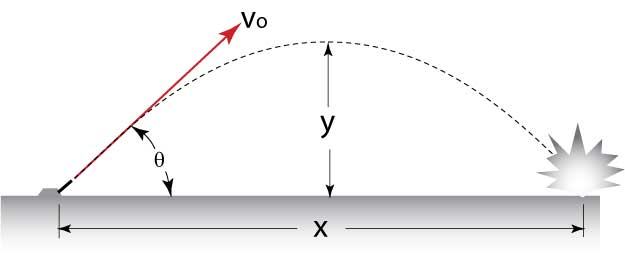
An  artillery shell is fired at an angle of 30° with respect to the horizon with an initial velocity of 760 m/s. Find the range of the artillery shell.


Solution

Place the origin at the bottom of the cannon. Define horizontal as the x-dimension with negative to the left and vertical as the y-dimension with negative downward.

x-dimension

Start by finding time
in  the y-dimension  >>>


vox  =  vo cos q

        = (760 m/s) cos 30°

        = 658 m/s


Dx = 1/2axt2 + voxt         

      = 0 + voxt

      = (658 m/s) (77.6 sec.)

      = 51, 060 m

    x  = 31.7 miles

x  = 31.7 miles

Note: In this problem the projectile is going faster than the speed of sound. Under such conditions, a real artillery shell's range would be significantly less less due to air resistance.

y- dimension


voy  =  vo sin q

        = (760 m/s) sin 30°

        = 380 m/s


y = 1/2ayt2 + voyt

but an instant before the shell hits, it will be zero meters above the ground, hence:

y = 0

0   = 1/2ayt2 + voyt

0   = 1/2ayt + voy

- 1/2ayt =  voy

t  =  -(2 / ay) (voy)

t  =  -(2 / (- 9.8 m/s2)) (380 m/s)

   = 77.6 sec


<<<   Finish in x-dimension

Conclusion and Significance

Typically, artillery crews would be able to measure the range to the target with a range finder. They would have to find the correct angle. these physics are more complex.

Mr

Mr. Rogers' Twitter Site

Check out other web sites created by Mr. R:


Want to learn more about movie physics in Star Trek and find out :
  • what makes Star Trek unique
  • how Star Trek compares to Star Wars
  • why the star ship Enterprise needs to remain in space
  • what should and shouldn't be done in space battles
  • what it takes to blast off and travel the galaxy
  • the basics of orbiting
Insultingly Stupid Movie Physics is one of the most humorous, entertaining, and readable physics books available, yet is filled with all kinds of useful content and clear explanations for high school, 1st semester college physics students, and film buffs.

It explains all 3 of Newton's laws, the 1st and 2nd laws of thermodynamics, momentum, energy, gravity, circular motion and a host of other topics all through the lens of Hollywood movies using Star Trek and numerous other films.

If you want to learn how to think physics and have a lot of fun in the process, this is the book for you!


First the web site,

now the book!


Mr. Rogers Home | Common Sylabus | AP Comp Sci I | AP Comp Sci II | AP Physics Mech | AP Physics E&M | AP Statistics | IB Design Tech | Southside

[ Intuitor Home | Physics | Movie Physics | Chess | Forchess | Hex | Intuitor Store |

Copyright © 1996-2009 T. K. Rogers, all rights reserved. Forchess ® is a registered trademark of T. K. Rogers.
No part of this website may be reproduced in any form, electronic or otherwise, without express written approval.