|
Mr. Rogers' Syllabus for AP Physics C: Mechanics (With IB Physics Topics) |
||||||||||
|
||||||||||
|
You have begun a mental journey to an exciting new territory -- the world of physics. Like mountain climbing the journey takes effort and self discipline but the view can be awesome. Physics is not just a collection of facts. It is the search for the basic principles behind the facts. These principles are often expressed as mathematical equations or models which makes applied physics or engineering amazingly effective for designing and improving equipment. Computers, for example, double in power every 18 months due to the fact that they're designed using applied physics. Your reward for venturing into the world of physics will be a sharper mind and deeper understanding. This is a calculus based, college level, physics class which covers mechanics for the American College Board AP Physics C Mechanics . Students passing this test may receive college credit. In addition, this class begins a two year course Physics course which covers the entire AP Physics C curriculum, as well as the IB Physics HL curriculum. The test schedule is as follows:
The Intellectual Challenge In college, physics is generally considered an intellectually challenging course. Correlations between the combined PSAT math and verbal scores with the passing rate in AP Physics bears this out. However, AP Physics Mechanics has an advantage over the equivalent college course in that it takes an entire year to present what would be considered a semester of material in college.
Textbook : Mr. Rogers will provide the following books: 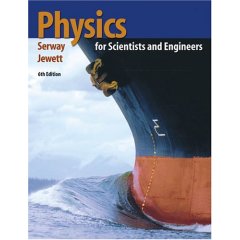 Physics
for Scientists and Engineers Physics
for Scientists and Engineers by Raymond A. Serway, John W. Jewett
Materials for Class Provided by the Student
Grading: (For details see Mr. Rogers' Syllabus - Information Common to All Classes.) Tests will be the single largest item and will be written as close to AP exam standards as possible. Course work will generally be finished in the third quarter leaving the rest of the year for review and various physics investigations (labs). The first semester exam will be taken directly from old AP tests. The exam grade will give you an indication of your standing on the future AP exam in enough time to take corrective action if needed. The fourth quarter grade will consist primarily of practice AP test grades. Generally, there is a high correlation between the practice exams and your grade on the AP test. Group IV Project: All juniors have to participate in a group IV project to meet the school's IB standards. This requires a minimum of 10 hrs of time outside of class and requires a student to design, conduct, and analyze a physics experiment as part of a team. Students must keep a log of their time and turn it in. The project is to be presented as a science fair project with a backboard. Projects deemed worthy will be sent to the regional science fair and earn extra credit. The first day-long meeting to select projects will be held in the Southside Media Center on November 18, 2011. Physics Investigations - Labs: We will be spending a significant part of our instructional time on various forms of practical activities. These will include formal lab write ups, mini-labs (informal write ups), computer simulation labs (Interactive Physics), and a few after school labs. We will also analyze several Hollywood movie scenes in class. Many investigations will be conducted with computerized data collection using a wide range of Vernier Lab equipment, video analysis, and sophisticated devices like air tracks and radio controlled robots. Other labs will use old fashioned meter sticks, stop watches, pendulums, spring scales etc. At least some of the labs will be designed by students. Deliverables from physics investigations will be submitted in electronic form in the AP Physics folder on the students virtual drive. Enrichment Assignment: You cannot master physics if you only think about it in the classroom. To encourage physics thinking in everyday life, once per quarter you are to review a Hollywood movie scene for physics content. The review will contain the following:
To analyze movies you will have estimate many of the parameters used in your calculation, often based on the size of objects in the movie. Estimating is a real world skill which is often required for major engineering projects. The analysis is to be submitted via the school's computer network as a computer file one week before the end of each quarter and will count as a lab grade. The file is to be labeled with the movie name and your name and can be either be an a Microsoft Word or Excel file.
The AP Exam: The Exam will be given on Monday May 12, 2014 at 12:00 pm. You must arrive 30 minutes early. The exam lasts 90 minutes and Consists of two parts: 45 min. for 35 multiple choice questions and 45 min. for three free response. AP tests are graded on a scale of 1 to 5 with 3 considered passing.
|

The following is offered as a general indication of how the class will be paced. Adjustments will be made as needed. First Quarter:
Second Quarter
Third Quarter
Fourth Quarter
Following the AP exam, students will still be required to attend class including the day of the semester exam even though students will not be required to take a semester exam if they have taken the AP Test. We will cover IB Physics HL topics in thermodynamics and wave mechanics and perform physics experiments. |
|||||||||||||||||||||||||||||||||||||||||||||||||||||||||||||||||||||||||||||||||||||||||||||||||||||||||||||||||||||||||||||||||||||||||||||||||||||||||||||||||||||||||||||||||||||||||||||||||||||||||||||||||||||||||||||||||||||||||||||||||||||||||||||||||||