| Practice Test | Study Guide |
|
||||||||||||||||
Relevance: Air resistance is a basic characteristic that determines all kinds of important issues including fuel efficiency of vehicles and terminal velocities of falling objects. |
|
|
|
Lesson 1 Key Concept: Falling in Uniform Gravity Fields Purpose: Introduce the concept of force fields using the most common force field gravity. Show how a velocity dependent force like air resistance interacts with a constant gravity field. Interactive Discussion: Star Wars vs. real life In Class Problem Solving:
|
|
|
| Title | Analysis of Low velocity Air Resistance for a streamlined and non-streamlined object |
| Purpose | Determine if air resistance is directly proportional to velocity for a streamlined and non streamlined object/ |
| Overview | Air resistance is often modeled as being directly proportional to velocity when included in mathematical models using Newton's second Law. |
| Data, Calculations | Perform regression analysis on the the data for each object using Minitab and plot the residuals. |
| Questions, Conclusions |
Was a linear relationship between air resistance and velocity
appropriate? How did the streamlined object differ from the non streamlined one. |
| Resources/Materials: | Wind Tunnel and associated equipment. |
|
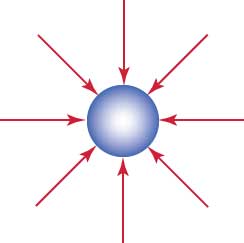
Gravity Fields Around Planets Section 13.1, 14.2
Homefun: Read 13.1 to 13.3; Problems 1, 3, 11, 23
|
 Read:
Insultingly Stupid Movie Physics
Read:
Insultingly Stupid Movie Physics|
Lesson 2 Key Concept: Non-Uniform Gravity Fields Purpose: Introduce the concept of force fields and show how it can be used in problem solving. Interactive Discussion: Objectives Demo 1: Demonstrate the inverse square law with a flashlight. Video Clip: Show a video clip of Armageddon when the asteroid is split in half and travels around the Earth. Estimate the tidal forces casued by the asteroid as it travels within 300 miles of Earth's surface. (teams of 2) In Class Problem Solving:
Resources/Materials: Flashlight
|
The Ultimate Transportation System -- a Tunnel Through the Center of a Planet. Relevance: Worm holes are a major yet unproven form of space travel in science fiction. In many ways, the hole-in-the-planet transportation system is analogous to a worm hole.
Homefun: Serway |
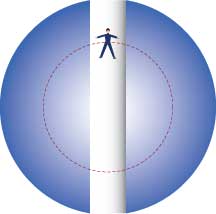 13. Derive an expression for the gravity field vs. radius inside a planet,
using the following:
13. Derive an expression for the gravity field vs. radius inside a planet,
using the following:Lesson 3 Key Concept: Gravity Field Inside a Planet Purpose: Introduce scaling factors and show how scaling factors in combination with simple harmonic motion and the universal gravitational equation can be used to analyze the g-field inside a planet.
In Class Problem Solving:
|
| Essential Question: How is gravitational Potential energy calculated when the g-field is not constant? |
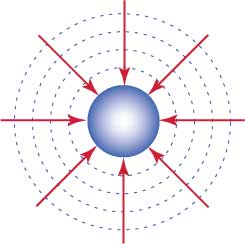
Gravitational Potential Energy From a Planet
|
 |
Equations
Comments
ΔU = - ∫ r (force function) (dr) ∞ The force will have a negative sign because it is an attractive force.
Ur - U∞ = - ∫ r (-[G(Mm)] / r2) (dr) ∞ ∞ is typically used as the location of zero gravitational potential energy Ur = - m [G(M) / r] Uf has to be negative in order to be lower than U∞.
- 19. Explain why the equation for potential energy vs. distance from a planet (a point source of gravity) is only valid above the planet's surface. (The amount of mass attracting an object toward the planet's center of mass changes as the object approaches the center of the planet, so the force as a function of r equation is different.)
Homefun: Read 13.4 to 13.6, Problem 27
Relevance: Gravitational potential energy is a key concept in space exploration. The energy required for getting off a planet's surface is a critical problem that could limit the exploration of planets by humans.
Lesson 4 Key Concept: Potential Energy Around a Planet Purpose: Relate gravitational potential energy to gravity force.
In Class Problem Solving:
|
| Essential Question: How can a spacecraft escape from a planet's gravity? |
Gravity and Orbits
-
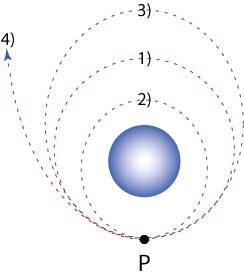 20. Circular Orbit: Calculate the velocity or radius (depending
on what is given) for circular orbits by combining circular motion
equations with the universal gravity equation.
(Note: r is the distance from the center of the planet to the
spacecraft, M = mass of planet)
20. Circular Orbit: Calculate the velocity or radius (depending
on what is given) for circular orbits by combining circular motion
equations with the universal gravity equation.
(Note: r is the distance from the center of the planet to the
spacecraft, M = mass of planet)
v = [(GM) / r]^0.5
- 21. Elliptical Orbit (speed lowered at P): Describe what happens to a satellite in circular orbit if it's tangential velocity is decreased.
- 22. Eliptical Orbit (speed increased at P): Describe what happens to a satellite in circular orbit if it's tangential velocity is increased.
- 23. Escape from Orbit: Calculate escape speed from the surface of a planet. (p. 407, note: r is the distance from the center of the planet to the spacecraft, M = mass of planet)
v = [(2GM) / r]^0.5
- 24. State the two critical speeds for orbits.
- 25. Calculate the radius and velocity required for a geosynchronous
or geostationary orbit.
- geosynchronous--the orbit returns the satellite to the same location in the in the sky at the same time every day.
- geostationary--a special case of geosynchronous orbit in which the satellite remains above a fixed point on the equator.
Note that an orbiting object can only remain in a fixed position above a point on the equator and then only if the radius and speed are correct.
Relevance: Orbit knowledge is key to an understanding of space travel, communication satellites, science fiction movies etc. Orbiting spacecraft are frequently incorrectly portrayed in science fiction movies.
Homefun: Read 13.4 to 13.7, Questions 1-10 ; Problems 41
Lesson 3 Key Concept: Orbiting and Escaping from a Planet Purpose: Derive the key equations associated with orbits.
Video Clip: Show a video clip of the Space Shuttle taking off from the surface of the asteroid in Armageddon. Calculate the escape velocity needed. How fast would the ship have to be moving to take off? Work in groups of two |
| Essential Question: How can the effects of air resistance be derived mathematically for a falling object? |
-
Falling With Air Resistance
-
- 26. Explain where air resistance comes from and why it should not be called air friction. For an object to move forward, it has to push air out of the way. The change in momentum of the air creates a force that resists the motion. This is sometimes referred to as an inertial force. There is friction between the air air molecules "rubbing" past the surface of the moving object but this force is very low except at supersonic velocities.
- 27. Derive a differential equation that accounts for the air resistance of a falling object, assuming the air resistance force is directly proportional to velocity.
bv - mg = ma
bv - mg = m(dv/dt)
m(dv/dt) - bv + mg = 0
- 28. using the above equation, derive an expression for the velocity of a falling object vs. time.
- 29. Calculate terminal velocity for a falling object with air resistance and compare it to a falling object without air resistance. (see page 162)
Relevance: Air resistance is a basic characteristic that determines all kinds of important issues including fuel efficiency of vehicles and terminal velocities of falling objects.