Mr. Rogers AP Physics C Study Guide -- Friction
| Unit Plan | Practice Test | Study Guide |
|
Mathematical models |
|
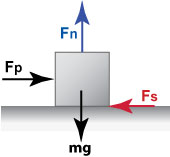
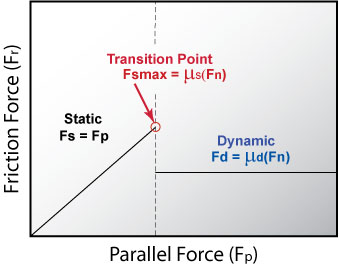
The 3 Equations of Friction Static friction (Fs): With static friction
there is no sliding, the friction force is exactly equal to the
parallel force.
Transition point: At the transition point, the equation shown at right can calculate the highest possible static friction and this is directly proportional to normal force, but only at the transition point. Otherwise, static friction is determined solely by the parallel force. Dynamic friction (Fd): When sliding occurs, the friction force remains constant. Typically dynamic friction is lower than static but never higher. Dynamic or sliding friction is influenced only by the normal force. |
Friction Force vs. Parallel Force
Note: there are three distinctly different equations. According to all three equations, contact area has no influence on friction. |
|
Key Principles |
|
Static vs. dynamic friction: Static friction
is typically greater than dynamic friction.
|
Acceleration in Cars: Static friction is the force that makes a car accelerate. |
|
Effect of Contact Area:
There is none.
According to our models of friction, increasing or decreasing the
contact area has no influence on friction. The model does assume no
deflection in the surfaces and no materials failures. For example, park
a car in mud and the friction conditions are rapidly altered as the
surface deflects beneath the tires.
|
Walking: Static friction is the force that propels a person forward when walking. |
| Tug of Wars: The team with the highest static friction force has the advantage in tug of wars. These contests are not won by pulling harder. | |
| Effect of 4WD: Two wheel drive (2WD) cars have less traction than four wheel drive (4WD) because in 2WD only part of the car's normal force acts on the driven wheels. Hence, the friction force acting on the car is lower than 4WD where all the normal force acts on the driven wheels. |
|
Problem Solving Tips: Newton's Laws |
| FBD: When
working problems with friction always draw a free body diagram.
usually these problems will end up as F = ma or Newton's second law
problems. (Remember static problems are simply a special case of F = ma
problems in which a = 0.)
|
||
| Direction of
Friction Force: The 3 mathematical models for friction can
calculate only the magnitude of the friction force. They are incapable
of giving the correct sign indicating the direction of the friction
force. You will have to judge the direction based on intuition and on
the free body diagram.
|
||
| Normal Force:
Remember that the normal force is not always equal to the weight force
(mg). This is especially true on slopes where the normal component of
the weight force often is equal in magnitude to the normal force or
when a pushing/pulling force is applied at an angle to the surface
where sliding might occur
|
||
| Air Foils: The normal force
of a race car can be increased using air foils without increasing
a vehicle's mass. In this situation the airfoil is designed to create
a downward rather than upward lift force. This downward force
increases normal force which increases the maximum possible static
friction. The effect: the race car will have a higher maximum acceleration
and higher maximum speed in turns. Otherwise these parameters are fixed by
the static COF and gravity field constant "g".
|
||
| Minimum Stopping
Distance: The minimum stopping distance of vehicles is independent
of mass according to our model of friction. As mentioned earlier, the
model assumes no deformation at surfaces and no material failures.
|
||
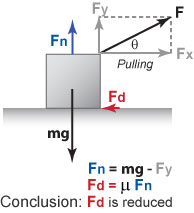
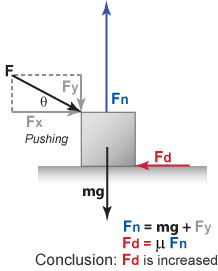
| Pulling vs. pushing:
Pulling an object using an upward angle will reduce the normal force
and friction that opposes motion.
Pushing an object using a downward angle will increase both the normal force and the friction that opposes motion. Pulling as described above will result in a higher acceleration than pushing assuming that everything else is equal. |
 |
 |
|
Example Problems |
|
Max Static Friction Problems |
Sliding Friction Problems |
Note: mass is not a factor |
Acceleration on a Slope |
Note: mass is not a factor |
Sliding with Pushing vs. Pulling: (see above) |
Note: mass is not a factor |
Sliding With Stacked Blocks: Block 1 sits atop block 2. A force F = 2.5 M1 g is applied to block 1. Find the acceleration of both blocks. COF conditions given. M2 = 1/2 M1. |
Note: mass is not a factor |
|
Note: mass is not a factor |
|
Note: mass is not a factor |
|
Vocabulary |
| Static Friction | Static COF = ms | |
| Dynamic Friction | Dynamic COF = md | Sliding Friction (same as dynamic) |