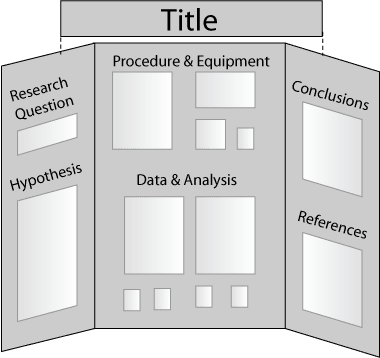
- Title
- Titles should be precise and description. Generally, they will include scientific jargon. Avoid cute titles.
|
The Basic Parts |
|
Poor Example |
|
Good Example |
- Research Question or Problem
- The research question should be specific and testable.
- Hypothesis
- A hypothesis Is not an educated guess. Guessing at an answer before the research is done can easily create bias. A good research project should not have even the slightest appearance of bias.
- A hypothesis is a proposal for answering the research question which states the basis for the proposal along with criterion for testing. If-then statements are an excellent form for the proposal.
A hypothesis should generally start with a brief discussion of the basis for the proposal. This should include references to a literature search, previous observations, or expert opinion.
A well written hypothesis will state the independent and dependent variables along with possible lurking variable, which need to be controlled. It will also discuss any assumptions that are made in the evaluation criterion, such as assuming that the resistance of wires in an electrical circuit is negligible or that air resistance acting on a falling object is zero.
Summary:
A hypothesis should contain the following elements:
- a brief summary of the basis for the proposal
- the proposal--generally an if-then statement--for answering the research question
- a brief discussion of the variables involved in the experiment (independent, dependant, controlled)
- a brief discussion of the assumptions made in the evaluation
A hypothesis should not predict the experiments outcome.
If soaking a tooth in Bob's cola for a prolonged period of time does not cause a measurable loss of enamel then it's doubtful that the brief contact during swallowing will cause significant damage to enamel. On the other hand, if the prolonged soaking does cause enamel loss, then it's likely that repeated use of Bob's cola could damage tooth enamel.
The dependent variable will be mass of the tooth and the independent variable time immersed in Bob's Cola. The Cola will be temperature controlled to normal body temperature. It is assumed that bacteria in the mouth, saliva, or other food residues in the mouth would not alter the results.
- Procedure
- The procedure should give enough detail so that a knowledgeable person could duplicate the experiment but does not have to include every minor detail. (Bullet statements are ok.) A procedure should show a labeled drawing or photograph of the apparatus and discuss how lurking variables are to be controlled. Mere lists of equipment are a poor substitution for a drawing or photograph of apparatus.
At Southside High School, Projects will not be accepted unless they have labeled drawings or photographs of the apparatus used in the experiment with the exception of math or computer science projects. Computer science projects must show a block diagram of the class configuration (such as the Bluej diagram), a screen shot of the GUI, and a section describing major algorithms (often this can be done by showing the code).
|
Some Dos and Don'ts Don't use first person singular or second person pronouns (in other words "I" or "you") in the write up. This is extremely bad form for technical writing. Don't over generalize your conclusions beyond what you have actually tested. Be specific. Do use statistical tools such as regression analysis, confidence intervals, and hypothesis tests in your write up. Do include photographs of your apparatus and of any observations you make. Do include supporting data, computer code, and additional analysis in a notebook on the table. Do use a taller than normal backboard, but only if you can fill it up. Do include models, or pieces of equipment along with your display. Do put a descriptive title, date, labels on each axis along with units on each graph. Do use SI (metric) units.
|
- Data and Analysis
- Will generally present the data in both a table and in graphical form. will include items such as pictures, statistical analysis of the data, descriptions of computer program output (often screen shots of output), and sample calculations.
At Southside High School, Projects will not be accepted unless they have actual raw data displayed on the backboard with a significant number of data points. A sample size of one for a given treatment is not acceptable.
- Conclusion
- The conclusion answers the research question by applying the evaluation criterion to the hypothesis. The researcher should summarize the basis for the conclusion, discuss possible experimental errors, and discuss how the investigation could be improved or continued in the future. A conclusion never introduces new data or analysis. The conclusion should include potential applications.
Summary:
- answers research question
- summarizes supporting data
- discusses possible experimental errors
- includes possible improvements
- includes future work
The middle panel should be 24" x 36" and the outside ones 12" x 36" with information arranged approximately as shown. the title should go on a panel attached above the tri-fold backboard. A good backboard will include pictures, drawings, and graphs as well as text.
At Southside High School, the middle panel will be constructed in PowerPoint or Adobe Illustrator and printed on the HP wide format printer, then glued to the back board using 3M spray adhesive. The document must be set up for the 24" x 36" size with appropriate sized fonts from the beginning.
Likewise, the side panels will be with be printed on a 24" x 36", split in half and glued to the appropriate sides.
Remember that changes cannot be made after the board is printed. Be sure to do the following beforehand:
- Run spell check
- Proof read everything--have a friend and your sponsoring teacher also proof read.
- Use appropriate sized fonts
- Use light color gradients in the background. Generally pure colors like green and blue are best. Gradients with with colors like beige can make the backboard look aged or dirty. Never use solid colors for the background.
- Check units: Make sure all quantities have appropriate units.
- Check all graphs and tables: they must have a title, proper lables, and correct units