| |
|
Chapter 6 Awesomely Entertaining Probability Practice Test |
| |
|
|
|
1 |
) |
What is the probability of rolling a combined score greater than 4
with a
set of dice (2 cubes)?
|
Score |
Probability |
Outcomes Making Up the Event |
| 2 |
(1/6)^2 * 1 = 1/36 |
1,1 |
| 3 |
(1/6)^2 * 2 = 2/36 |
1,2; 2,1 |
| 4 |
(1/6)^2 * 3 = 3/36 |
1,3; 3,1; 2,2 |
| Total |
1/6 |
|
- (Prob. greater than 4) = 1 -
complement
- = 1 - 1/6
- = 5/6
|
| |
|
|
|
2 |
) |
What is the probability of getting at least two or more heads when tossing 3
coins?
|
Score |
Probability |
Outcomes Making Up the Event |
| 2 |
(1/2)^3 * 3 = 3/8 |
HHT, HTH, THH |
| 3 |
(1/2)^3 * 1 = 1/8 |
HHH |
| Total |
1/2 |
|
|
| |
|
|
|
3 |
) |
What is the key assumption underlying all probability based predictions?
Law of Large Numbers |
| |
|
|
|
4 |
) |
The probability of event A is 10% and event B is 20%. The events are
disjointed. What is the intersection of the two events?
0 |
| |
|
|
|
5 |
) |
The probability of event A is 10% and event B is 20%. The events are
disjointed. What is the union of the two events?
30% |
| |
|
|
|
6 |
) |
If men wear red shoes 10% of the time while women wear red shoes 20% of the
time and there is a 55% probability that the next person walking by will be
male, what is the probability that a female will walk by wearing red shoes?
0.45 * 0.2 = 0.09 |
|
7 |
) |
Refer to the question above. What percent of all people wearing red shoes
will be male? 38% |
| |
|
|
|
8 |
) |
If there is a 60 % chance that a person will be right, what is the
probability of all the people being wrong in a 5 person group?
(0.4)^5 = 0.01024 |
| |
|
|
|
9 |
) |
If 35 % of the people in the USA have brown hair, what is the probability of
finding a group of 5 people in which exactly one person has brown hair.
(0.65)^4 * 0.35 * 5 = 0.312 |
| |
|
|
|
10 |
) |
If 10 % of the people in the USA have green eyes and 20 % have blond hair,
what is the probability of finding a person with both green eyes and blond
hair? (assume green eyes and blond hair are independent)
0.1 * 0.2 = 0.02 |
| |
|
|
|
11 |
) |
If 20 % of the people in the USA have blue eyes and 70 % have brown hair,
what is the probability of finding a person with blue eyes or brown hair?
(assume blue eyes and brown hair are independent)
0.2 + 0.7 - (0.2 * 0.7) = 0.76 |
| |
|
|
|
12 |
) |
You flip a coin and get heads all 27 times in a row. Assuming that the coin
is fair, what is the probability of getting heads a 28th time.
0.5 |
| |
|
|
|
13 |
) |
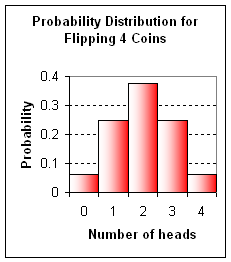
Draw a graph of the
probability distribution for flipping 4 coins
|
Score |
Probability |
Outcomes Making Up the Event |
| 0 |
(1/2)^4 * 1 =
1/16 |
TTTT |
| 1 |
(1/2)^4 * 4 =
4/16 |
HTTT, THTT, TTHT,
TTTH |
| 2 |
(1/2)^4 * 6 =
6/16 |
HHTT, HTHT, HTTH, THTH, THHT,
TTHH |
| 3 |
(1/2)^4 * 4 =
4/16 |
HHHT, THHH, HTHH, HHTH |
| 4 |
(1/2)^4 * 1 =
1/16 |
HHHH |
| Total |
16/16 |
|
|
 |
|
|
|
|
|
|
14 |
) |
The probability of getting an A in English is 20% and the probability of
getting an A in math is 40%. The probability of getting an A in both
classes is .04. are the 2 events independent?
For independence: P(A and B)
= P(A) * P(B)
- P(A) * P(B) = 0.2 * 0.4
-
= 0.08
-
- Since 0.08 ≠ .04 getting an A in English is not
independent from getting an A in math
|
|
|
|
|
|
15 |
) |
P(A) = 40%, P(B|A) = 20%, P(B) = 30% find P(A or B).
0.4 + 0.2 - 0.4(0.2) = 0.62 or 62% |
|
|
|
|
|
16 |
) |
P(A) = 40%, P(B|A) = 20%, P(B) = 30% find P(A and B).
0.40 (0.20) = 0.08 or 8% |
|
|
|
|
|
17 |
) |
P(A) = 40%, P(B) = 30%, for independent events, find P(A or
B) 0.40 + 0.30 - 0.40 (0.30) = 0.58 or
58% |
|
|
|
|
|
18 |
) |
P(A) = 40%, P(B) = 30%, for independent events, find P(A and
B) 0.40 (0.30) = 0.12 or 12% |
|
|
|
|
|
19 |
) |
P(A) = 40%, P(B) = 30%, for disjointed events, find P(A or B) 0.40 + 0.30 = 0.70 or
70% |
|
|
|
|
|
20 |
) |
P(A) = 40%, P(B) = 30%, for disjointed events, find P(A and
B) 0% |
|
|
|
|
|
21 |
) |
How many possible outcomes are possible when rolling a pair of dice?
36 |
|
|
|
|
|
22 |
) |
What is the probability of getting 7 when rolling a pair of dice?
1/6 |
|
|
|
|
|
23 |
) |
Are disjointed events independent?
NO! |
|
|
|
|
|
24 |
) |
20% of the people read newspaper A, 30% read newspaper B. 10% read both
newspapers. What % read no newspapers? Are reading newspaper A and B
independent events? = 1 - 40% or 60% |
|
|
|
|
|
25 |
) |
If an individual has a 60% chance of arriving at the correct verdict, what
is the probability that no one on a jury will arrive at the correct verdict?
0.4^12 = 1.68 x 10⁻⁵ |
|
|
|
|
|
26 |
) |
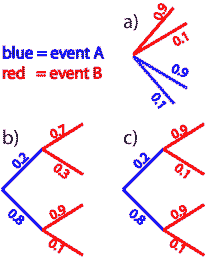 Given
the tree diagrams at left, determine if P(A) and P(B) are disjointed,
independent or conditional for each tree. Given
the tree diagrams at left, determine if P(A) and P(B) are disjointed,
independent or conditional for each tree.
A)
___Disjointed__________________________
B) ___Conditional_________________________
C)
___Independent________________________
|
|
27 |
) |
The sheriff wants to set up random road blocks, stop each car and give each
driver a breathalizer test to see if he or she is intoxicated. If a person
is drunk, the test is 99% accurate but if a person is sober, the test is 98%
accurate. 1% of all drivers are legally drunk. Of the individuals identified
by the test as drunk, what % are actually sober? Offer your analysis to the
sheriff along with recommendations for how he should proceed. What is the
probability of getting an inaccurate test?
Draw a tree diagram to obtain the following:
|
( Of individuals identified by the test as
drunk, % actually sober ) |
= |
[ 0.0198 / ( 0.0198 + 0.0099 ) ] x 100% |
| |
= |
66.7% |
| |
|
|
|
( probability of inaccurate test ) |
= |
(0.0198 + 0.0001 ) x 100% |
| |
|
1.99% |
Advice: test only for cause in
order to avoid prosecuting a high % of innocent people.
|