| Essential Question:
How
can materials be described? |
Introducing and Classifying Materials
-
Define
-
atom
-
molecule
-
alloy
-
composite.
-
Describe and differentiate between the
three main types of bond (attraction between atoms) :
State that materials can be classified into groups according to similarities in
their microstructures and properties.
Explain that several classifications are recognized but that no single
classification is “perfect”.
State that materials are classified into groups:
-
timber - natural wood or composite (plywood, masonite, particle board)
-
metals - ferrous (iron or iron alloys) or nonferrous
-
ceramics - earthenware, porcelain, stoneware, and glass
-
plastics - thermoplastics or thermosets
-
textile fibers - natural or synthetic
-
food - vegetable or animal origin
-
composites - fiber glass, carbon fiber
|
Assessment --
Materials Vocabulary
IB Standard:
Various (see objectives 1 and 2 above).
Specifications: Write definitions for the terms in objectives 1 and
2
Deliverable: Place the completed Word file in the IB Design
Technology folder of your student drive.
Work Group: individuals. |
| Essential Question:
What
makes a material appropriate? |
Properties of Materials (4h)
Physical Properties
-
Define the physical properties of:
-
Explain a design context where each of the properties above is an
important consideration.
| Essential Question:
Does form follow function? |
- The Engineering Context
-- a specialized area of the design context
- Mechanical and civil engineers are the
primary types concerned with mechanical parameters like stress,
strain, stiffness,
elastic stability, etc. Mechanical engineers use this
type of information to design the structure for aircraft,
pressure vessels, and all kinds of different machines. Civil engineers use it for designing buildings, bridges , and other types of structures.
Engineers are primarily concerned with
the safety, function, and practical aspects of design rather than
the aesthetics. |
-
Define stress
and explain how it is different from pressure although both use the same
units.
-
Stress = (force) /
(unit of area) at any given point inside an object
-
Pressure = (force) / (unit of area)
applied to the outside surface of an object
-
Pressure is an external load. Stress is an
internal condition resulting from external loads of forces and pressures.
The stress inside a structure can be orders of magnitude higher than the
external pressure loads applied to it.
Relevance: Misconceptions about basic engineering principles are
the life blood of conspiracy theorists. These conspiracies include
the Murrah Federal Building bombing, the Twin Towers collapse on 9-11, and
the Kennedy assassination. Conspiracy theories sometimes gain enough
momentum to trigger government investigations costing millions of dollars.
While this is not inherently harmful, it is a waste of funds when the
theories are based on engineering or scientific nonsense.
-
Define strain: the ratio of a change in dimension to the
original value of that dimension.
Strain = (change in length) / (original length)
-
Mechanical Properties
-
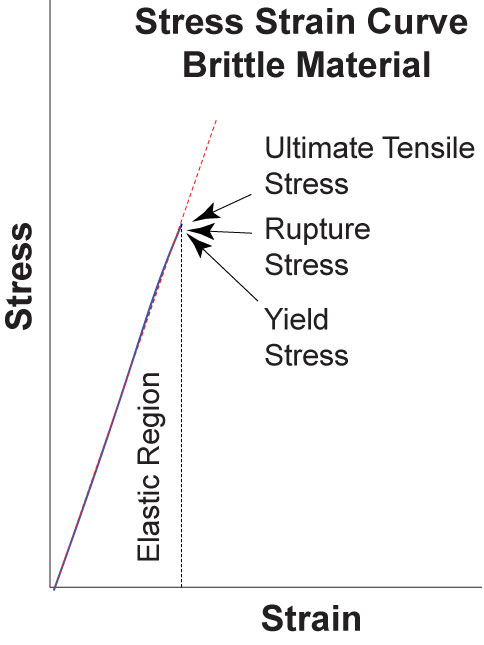
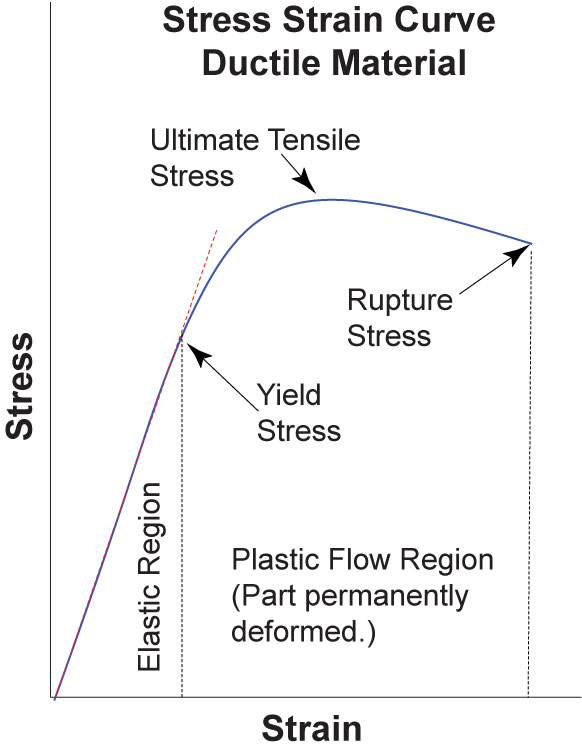
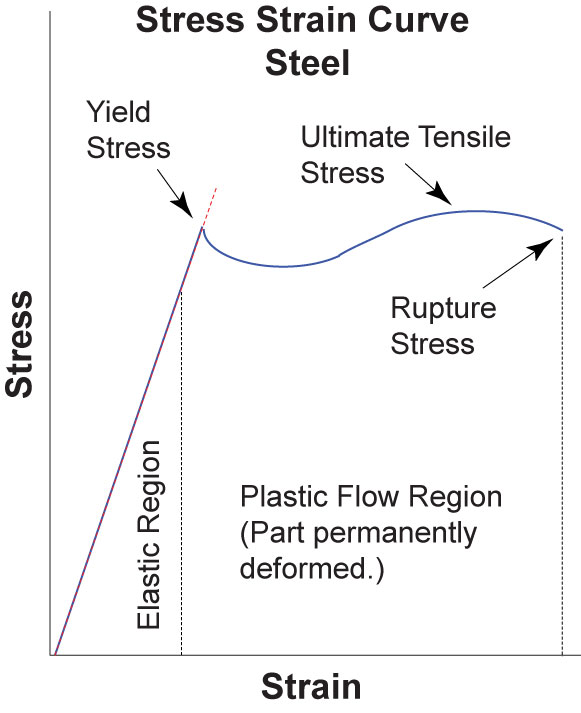
tensile strength - the amount of tensile stress a
material can withstand before failure
-
yield stress
- max stress before
permanent deformation
-
ultimate tensile stress
- max
stress before catastrophic failure
-
rupture stress
- max stress at
catastrophic failure
-
stiffness
-
modulus of elasticity or Young's modulus. Note, Young's modulus is a
material property. The stiffness of a structure depends on both the
material and the design. Area
moment of inertia (see 18 below) is a key design related indicator of
stiffness.
-
toughness
-
resistance to
abrasion and
cutting.
Work
required to make a material fail catastrophically. Tough materials are
generally not brittle.
-
ductility -
ability to extrude
-
malleability
- ability to shape
plastically. Note: the IB syllabus
makes a special point to make a distinction between ductility and
malleability. For all practical purposes, ductile materials are also
malleable.
-
Explain a design context
where each of the above properties is an important consideration.
-
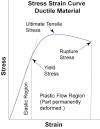
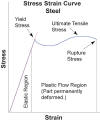
Draw and describe a stress/strain
graph (see at right)
-
elastic
region
-
yield stress
-
plastic
flow region
-
ultimate stress (UTS).
|
 |
 |
 |
| Essential Question:
What
keeps a building from falling down? |
-
Explain the relationship of the 2 most common
structural members (beams and columns).
-
Beams :
typically horizontal structural members designed especially to resist
bending moment and shear loads. (Note: moment arm = distance from load to
pivot point.)
-
Columns: vertical structural members
designed especially to resist compression loads
-
Identify types of load.
|
|
Compression/Tension:
compression is squeezing together. Tension is pulling apart. Compression
can be considered negative tension. |
 |
Shear: forces moving in
opposite directions
on each side of an element similar to the action of a pair of scissors
or shears. |
 |
Bending Moment: a twisting action |
-
Calculate factor of safety .
Factor of safety) = (Design load) /
(normal maximum load)
-
Explain why factor of safety is important.
- uncertainty about normal maximum load:
a designer has to make an educated guess about what the maximum load
will be.
- fatigue cracks: caused by the
cycling if stresses particularly fro tension to compression. Some
materials such as steel have a fatigue limit. If the stress is kept
below the fatigue limit a crack will never form. Cracks grow larger over
time until catastrophic failure.
- corrosion
- fire
- shock loads
|
Assessment -- Investigation
of conspiracy theories about the
bombing of the Alfred P. Murrah Federal Building
IB Standard:
Various including stress, strain, stiffness, beams, factor of safety etc..
Specifications: Research the
bombing of the Alfred P. Murrah Federal Building and locate a conspiracy site
about it.
- W
rite
a paragraph describing what happened
and
give your source including the url.
Write another paragraph using non-conspiracy theory sources
describing why the building collapsed
and give your source including the url..
Write a third paragraph summarizing a conspiracy theory
about the collapse and give your source including the url.
Write a final paragraph explaining the flaws in the above conspiracy theory. Use
the vocabulary and knowledge you have gained concerning materials, such as, stress
and strain, external loads vs. internal stresses etc.
Deliverable: Place the completed Word file in the IB Design
Technology folder of your student drive. Call the file:
Murrah Investigation <your name>.
Work Group: individual. |
| Essential Question:
Why is stiffness important in
structures like bridges, buildings, wings, etc.? |
-
Calculate the stiffness of a structure. Relevance:
Stiffness is a critical characteristic of structures that determines not
just safety and function but also the emotional response of users. For
example a flexible floor in a multi-story building.
stiffness = (load) / (deflection)
-
Explain how both modulus of elasticity and
moment of inertia are related to stiffness.
-
Modulus of elasticity
or
Young’s modulus
(a material property) - directly proportional to stiffness
-
Area Moment of inertia (a design property)
- directly proportional to stiffness
-
Calculate the Young’s modulus of a material.
(Young’s modulus)
=
stress / strain
-
Calculate area moment of inertia for a beam with
a rectangular cross section. Area
moment of inertia is a key design related indicator of stiffness. The higher
the number the stiffer the structure.
- I 0 = (bh3) /
12
-
- where:
- I 0 = Area Moment of Inertial
for a rectangular cross section of a beam
- b = width
- h = height in the direction of the load
-
Define elastic stability (the tendency of a
structure to resist buckling) and state why it is an important consideration
in design.
-
Give examples of elastic instability.
-
External pressure applied to a plastic soft
drink bottle's exterior
-
Long thin columns
|
Assessment -- Investigation
of
relative stiffness of beams
IB Standard:
Various including stiffness and beams.
Specifications: Find dimensions for a 2x4, 2x6, 2x12 made of
lumber. Calculate the relative stiffness (area moment of inertia) of each beam
in both its strongest and weakest position. From a stiffness and load
standpoint, explain why 2x4s are generally used in walls, 2x6s in ceilings,
and 2x8s or 2x12s in floors as the structural members.
Deliverable: Place the completed Word file in the IB Design
Technology folder of your student drive.
Work Group: individuals. |
|
Aesthetic characteristics
-
Outline the characteristics
of taste, smell, appearance, texture and color.
-
Explain a design context
where each of the above characteristics are an
important consideration.
The IB Properties/Materials Matrix
-
Explain how all the groups
and sub-groups of materials shown above can be
organized into a properties/materials matrix
-
Explain the relative values
of the properties in the IB properties/materials
matrix.
Assessment: Unit exam objectives 1-24 |