|
Mr. Rogers AP
Computer Science A - Third Quarter Objectives |
Syllabus
|
Latin/Greek Root Words
|
|
|
(Comp
Sci
connection) |
|
Major Software Project
Chapters 15, 16, 17,
Basic GUI
Information (scroll down to appendix D)
|
Essential Question:
How can we create a
user-friendly, event-driven program? |
Design and create a major software project
with a GUI. (See major software project specifications
here.)
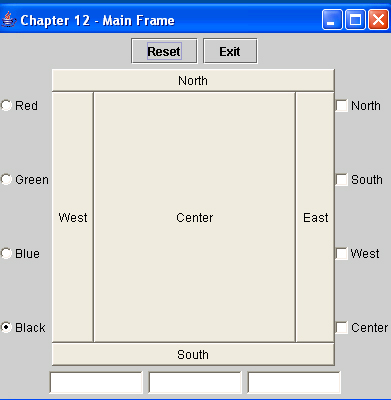
Correctly use grid layouts.
|
|
- Correctly use boarder layouts.
|
|
-
Be aware that with java graphics the origin is in the
upper left corner of the screen and that each pixel's location is given by
a pair of integers representing x and y coordinates.
-
Successfully create action listeners.
|
-
Create a graphical user interface with a
menu bar and pull down menus.
 |
|
Programming assignments
(summative/formative assessment):
1. Modify
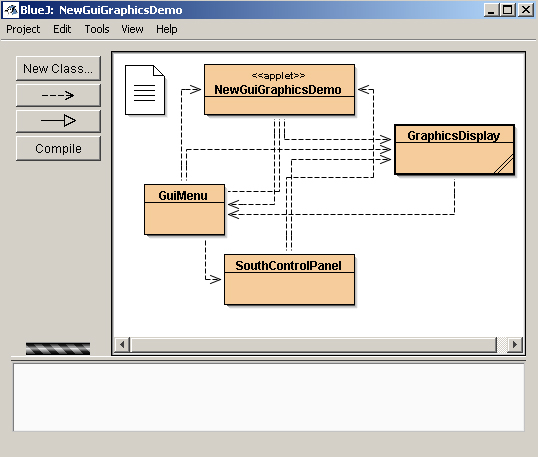
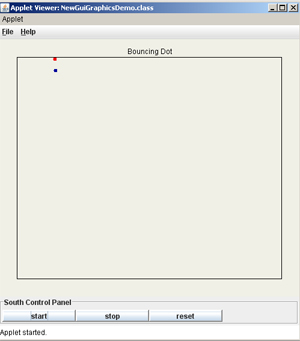
NewGuiGraphicsDemo as follows:
-
Add one or more
bouncing objects.
-
Modify the
program so that the background changes color when the start button is activated
and the color changes back when the reset button is activated.
-
Add a slider that
adjusts bounce speed to the South Control Panel.
-
Add a menu item
that changes the dot size and contains a radio button group with the following
options: small, medium, and large.
-
Make a unique
event driven modification of your choice.
2.
|
Essential Question:
How does OOP
development using Java compare with the process of writing a book
using English? |
Chapter 11: Class Hierarchies
and Interfaces
Relevance:
Class Hierarchies and
Interfaces make it easier to organize and manage the
creation and maintenance of large software projects
similar to the way the table of contents, chapters, and appendices help organize
books.
-
Name 2 reasons why duplicate code is a bad
idea.
(wasteful, hard to maintain)
-
Explain the purpose of having a hierarchy of
classes (inheritance) and how it helps facilitate functional decomposition
( breaking down an overwhelmingly complex task into smaller doable tasks).
-
Define polymorphism and explain why it is
useful (page 293).Polymorphism is the situation in
which an inherited method can have more than one meaning.
Example:
overriding of methods:
the code within a method
inherited from a super class can be altered by recreating the method in
the subclass. However, this only alters the code when the method is called
by an instance of the subclass. When the method is called by an instance
of the super class, the original unaltered code is run.
NOT generally considered polymorphism--overloading of methods:
these are methods in the
same class that have the
same name but different parameters.
- Create and use abstract methods
(methods that are declared but not defined).
- Example declaration:
- public abstract int
tax(); // Note
that there is no code, not even brackets.
- Create abstract classes (classes with one or
more abstract methods).
- Example declaration:
- public abstract class
People {
-
. . .
- }
- Correctly declare an interface.
- Example declaration:
- public interface Career
{
-
. . .
- }
- Define the term concrete class.
Has no abstract methods.
-
Be aware that all classes automatically extend
the class Object.
- State the difference between an:
interface
-- contains only abstract methods, no
instances of the interface are allowed and it has no constructor. Fields in
an interface can only be symbolic constants.
abstract class
-- contains one or more abstract
methods. no instances of the abstract class are allowed
concrete class
-- contains no abstract methods.
Instances of the concrete class are allowed
-
Be aware that Java does not allow the creation
of objects (instances) of an abstract class or an interface.
- Describe the reasons for using an interface.
- A class can only extend
one class but can implement multiple interfaces.
- Interfaces make code
readable and uniform by standardizing the labeling of procedures (methods).
-
Be aware that if a class implements an
interface (and it can implement as many as it wants), it must supply all
the methods specified in the interface.
- Invoke a superclass's constructors (p.298).
To initialize fields inside a super class:
- a superclass's constructors must be used to
initialize private fields
- a superclass's constructors can be called
inside the subclasses constructor using super
(<appropriate arguments>);
- if a superclass constructor is not
called from the sub class constructor, the no-arguments-constructor of the superclass is run (see below). If a no-arguments-constructor doesn't exist,
a compiling error results.

- Write programs that extend a given class using
inheritance.
- Write programs that implement interfaces.
-
Explain how polymorphism applies to
interfaces.
Homefun
(summative/formative assessment):
Exercises 1-5
Programming assignments:
1. Pumpkin Farm Simulation:
Create the following:

Squash class
-- has a protected
weight field and a grow method that adds a
random double between zero and 10 to weight each time it's run (representing one
week's growth).
Pumpkin class
-- inherits the Squash class
Crop interface
-- contains 1 abstract method called yield ( ) that returns a double representing the yeild from a crop.
PumpkinFarm class
-- implements Crop, creates a field with an array of ten pumpkin objects
(starting weight = 0) and
grows them for 10 weeks. Outputs the total weight of pumpkins using the
yield method.
2. Modify
NewGuiGraphicsDemo to act as a diffusion simulation as follows:
-
Add a Dot class
that defines the characteristics of a dot.
Include public fields for the x and y
coordinates, x and y velocities, and the color of the dot (called dotColor).This class should have 2
constructers. The first will have no parameters or code in it (it's required for
subclasses). The second will
have
an Color parameter that sets a
value for dotColor and an int parameter that sets a value for x-coordinate. All
other initial values of fields will be set using appropriately sized random
number generators. Remember, the x-coordinate will locate the dot on the correct
side of the screen.
-
Add a RedDot and a BlueDot class. Have both extend the Dot
Class.
Both classes will set the respective color of the dot (red or blue) and set the
correct screen side by calling the
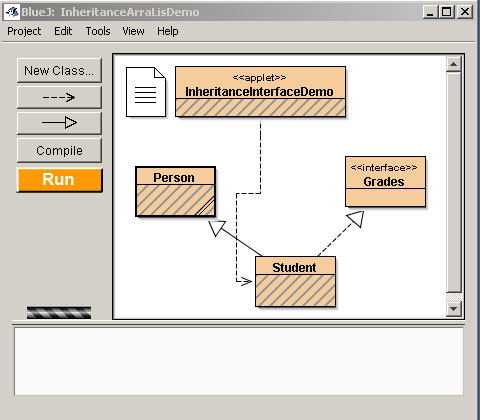 super class constructor in their constructor.
To see how this is done, see the
InheritanceInterfaceDemo
code.
super class constructor in their constructor.
To see how this is done, see the
InheritanceInterfaceDemo
code.
-
Create an ArrayList of red dots that start on the left side
and an ArrayList of blue dots that start on the right side.
The 2 ArrayLists will be
created in the GraphicsDisplay class (see the example code at right).
-
Create a vertical barrier in the middle of the screen. The
barrier is to have a hole in it so that dots can bounce through the hole but not
through the barrier.
This code will also reside in the GraphicsDisplay class
Summative Assessment: Test
Chap 11 Objectives 1-15
|
Essential Question:
How can we search and sort millions of volatile pieces of similar
information without having to create millions of lines of code? |
Chapter 13: Searching Sorting and Other Array Elements
Relevance:
Searching and sorting are the two of the most common types of
algorithms for manipulating data records..
- Sequential
and binary searches: Write the code. See Diagram of a Binary Search Algorithm
Assignment:
Read
Dragons and Binary Search
-
Given a set of data records be able to pick the above search method which
will be likely to run the fastest.
-
Write the code which can find the largest or smallest element in an array.
- Correctly use loops for the following:
- traversals
- insertions
- deletions
- Selection sort: Write the code
.
- Initialize an int variable n to the largest index
in the
array.
- Find the biggest in the first (n) elements
array.
- Swap the biggest for the element n.
- Perform n - -
- Repeat while n >= 1.
- Be as one with the descriptions of the three sort
methods mentioned on page 342
Hypothetical Time Required for Sorting Objects vs
Big-O Notation
|
Items to sort |
2 |
10 |
100 |
|
O(n) |
1 |
5 |
50 |
|
O(n2) |
1 |
25 |
2500 |
|
O(nlogn) |
1 |
17 |
332 |
-
Given a set of data records be able to pick the above sort method which
will be likely to run the fastest.
-
Name the search and sort algorithms which could be categorized as divide
and conquer techniques. binary search, merge sort
-
Be aware of the methods associated with the Array class.
-
Be as one with chapter 3 of
Gridworld.
- Homefun: Exercises 1- 6,
- Programming assignments: Lab 13.4
Keeping Things in Order,
Lab 13.9 Benchmarks, Exercise 12.
13.1 Array Search
-
Create a program with an integer array containing 20
random numbers. Use code to initialized the array with random integers from 0 to
100. Using command line input search the array for a specific number.
Output the entire array, the highest value, the lowest value, and the index
number where the number you searched for was found or a statement that the
number was not found.
-
Add a selection sort (write
the code, see p. 332) to the above and output the sorted
array by creating a Sort class with selection sort method in it.
-
Add the code for a binary search which will then
search for the element specified earlier in command line input and output the
index where it exists. If the value is not found it will output "Not found".
Configure the program to find multiple instances of the the search target.
Test: Chap 13 Objectives 1-6
|
Essential Question:
How does Java allow a program to read and write to the hard drive? |
Chapter 14: Streams and Files
Note:
Chapters 14 covers
items not typically not found on the AP exam but will be useful in creating your
personal project.
-
State the 2 major categories of files.
-
binary
-
ASCII or Unicode (text)
-
Describe how the lines in text files are ended ( CR+LF).
-
Be as one with the following vocabulary:
buffer, stream,
random-access file.
-
Be aware that a stream can be opened for input or output but
not both at the same time.
-
Be aware that a random access file can start reading or
writing at any point in the file. It can be opened for both reading and
writing at the same.
-
Be aware that text files tend to have different lengths and
are usually treated as streams while binary files of fixed length are treated
as random-access files.
Note:
Chapters 15, 16, and
17 deal with graphics, GUI components, mouse, keyboard, sounds and images. These
items are typically not found on the AP exam but will be useful in creating your
personal project.
Assignment: Continue working
on your personal project.
- GridWorld Part 3:
GridWorld Classes and
Interfaces
- In Class Group Activity:
We will do
the group activity at the end of Chapter 4 in class
- HomefunRead Chapter 3 , Do you know? Set 6
-